Hi,
Scenario:
We have three large outside open area sites that are currently providing Wi-Fi for staff via TP-Link Omada, given the size of the site there are multiple bridge access points and standard access points. The intention it to provide a new paid service that customers can purchase Wi-Fi for a set period of time i.e. 12,24,48,72 hours. We don’t want to have to rip out the current Wi-Fi hardware as there has been a large investment here.
Questions:
I understand that you don’t directly support the Omada system or its portal service but you do support Mikrotek. If were to swap out the current router for a Mikrotek and configure it to talk to PowerLynx would this work with our current solution? I guess the question here is if the MikroTek portal will work correctly with the Omada, I have very little knowledge of MikroTek so I don’t know what is/isn’t possible with the device.
The internet is provided by a Starlink connection, does the PowerLynx service require the MikroTek router to have a static IP address?
As mentioned, we have 3 sites that will be using the service, how does the licensing work in this situation? Do we need multiple instances of the PowerLynx service or can all three sites be serviced by one?
Thanks
Rob
Hello Rob,
Thank you for reaching to Powerlynx forum.
I’m Alex, Support Engineer at Powerlynx.
Regarding MikroTik, TP-Link Omada, and Starlink Integration
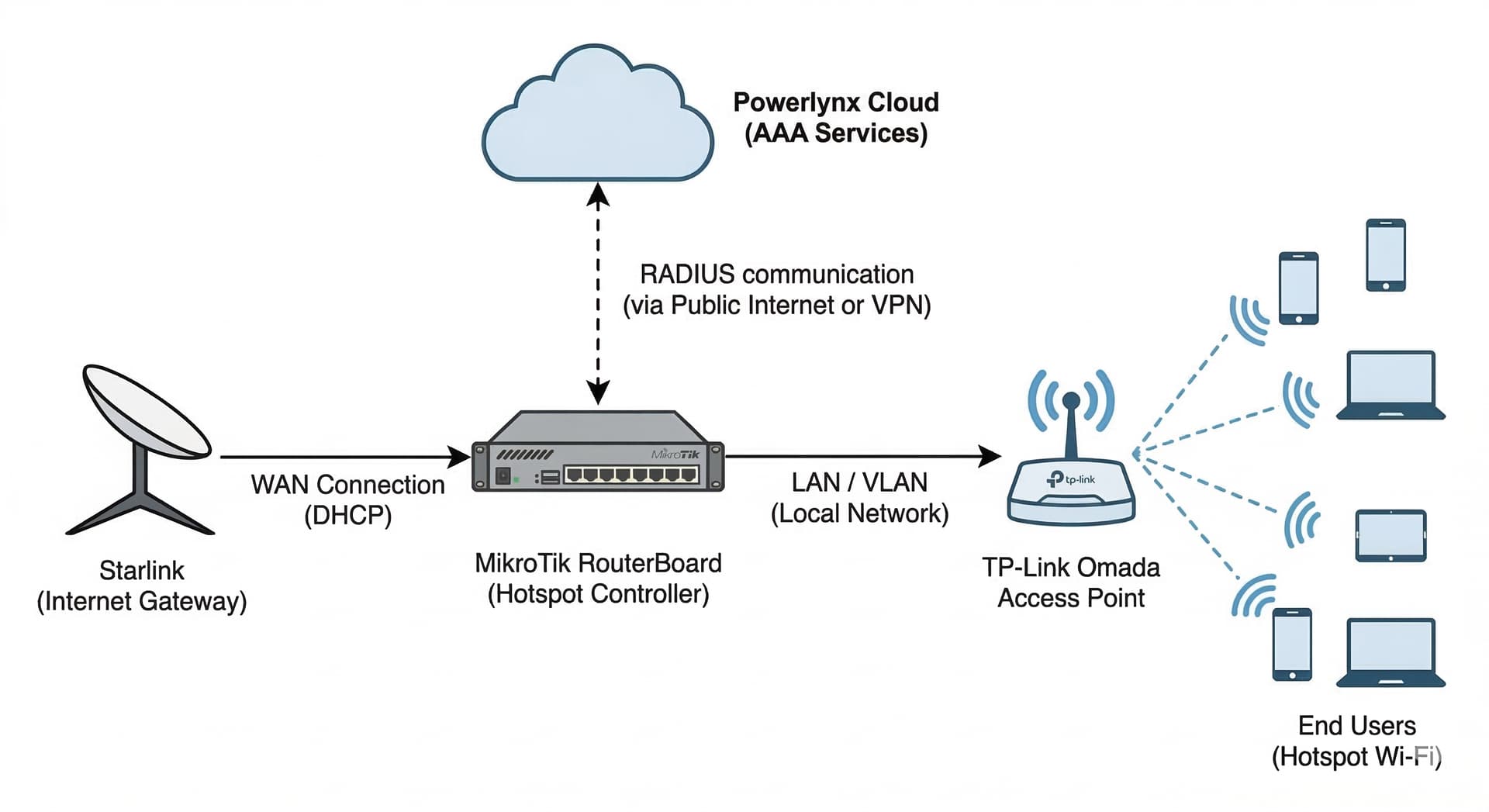
In your scenario, the recommended logical network topology is as follows:
Powerlynx (Cloud) → Hotspot Controller (MikroTik) → Access Points (TP-Link Omada)
- Access Points (AP): These act as wireless stations for end users, forwarding all traffic to the MikroTik hotspot controller.
- Hotspot Controller: A MikroTik device connected to both Powerlynx and the local network. It is responsible for intercepting unauthorized traffic and redirecting users to the Powerlynx Splash Page. In this setup, Starlink serves as the primary WAN gateway for the MikroTik device.
- Powerlynx: Provides AAA (Authentication, Authorization, and Accounting) services. It instructs the MikroTik controller on session management, including when to allow, throttle, or disconnect specific users.
Visual Network Topology
This is a diagram representing this architecture for your reference:
Example Configurations:
Licensing and Scalability
Question: We have 3 sites that will be using the service; how does the licensing work? Do we need multiple instances or can all three sites be serviced by one?
Powerlynx licensing is based on concurrent online users (sessions) rather than the number of physical network sites or controllers.
You do not need multiple Powerlynx instances. All three of your sites can be managed from a single Powerlynx instance, allowing for centralized management of your data plans, customers, and vouchers across all locations.
Next Steps
You can register for a trial session and begin testing immediately:
Additional Resources:
If you need further assistance, feel free to reach out to us at support@powerlynx.app.
Hi Alex
Thanks for the compressive reply. Can I just confirm that I don’t need a static IP address on the WAN link? I am guessing that PowerLynx will be the VPN host and the MikroTek the client?
Thanks
Rob
Hi Rob,
Yes, you are correct.
You do not need a static IP address if you are using a VPN.
Best regards,
Alex